
From a parent currently searching for colleges for my son at a private prep school
When we started this process I pictured a simple path: play travel ball, shine at showcases, get exposure, and somewhere along the line a D1 or D2 offer would show up. What I’ve learned so far is that the reality is more complicated — and much rarer — than the highlight reels make it look.
Below I break down the real differences between divisions, bust the big myths, and share a realistic, practical game plan that’s working for our family.
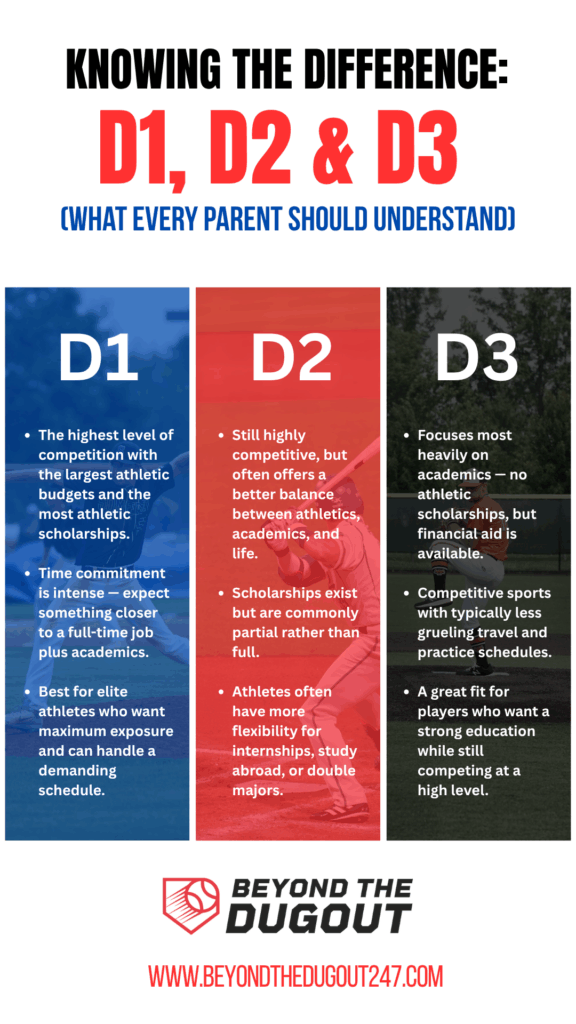
Knowing the difference: D1, D2 & D3 (what every parent should understand)
Understanding the divisions changed the way we plan exposure and set goals. Here’s the useful, parent-friendly version:
Division I (D1)
- The highest level of competition with the largest athletic budgets and the most athletic scholarships.
- Time commitment is intense — expect something closer to a full-time job plus academics.
- Best for elite athletes who want maximum exposure and can handle a demanding schedule.
Division II (D2)
- Still highly competitive, but often offers a better balance between athletics, academics, and life.
- Scholarships exist but are commonly partial rather than full.
- Athletes often have more flexibility for internships, study abroad, or double majors.
Division III (D3)
- Focuses most heavily on academics — no athletic scholarships, but financial aid is available.
- Competitive sports with typically less grueling travel and practice schedules.
- A great fit for players who want a strong education while still competing at a high level.
Download the Infographic to Share!
The scholarship myths — and what’s actually true
These are the ideas most parents repeat — but they’re misleading.
Myth 1 — Play the biggest national showcases and you’ll get seen.
Truth: Some showcases are legitimate recruiting hubs; others are marketing. Always ask for names of confirmed coaches and the level of staff attending (head coach vs. volunteer assistant). Pay for verified recruiting value, not a flashy title.
Myth 2 — A 90-mph fastball or huge exit velo means a scholarship.
Truth: Tools get you noticed, but coaches recruit people they can trust. Consistent mechanics, coachability, maturity, and academic eligibility matter as much — sometimes more — than raw numbers.
Myth 3 — Paying more guarantees exposure (and a better outcome).
Truth: Money buys entry to events, not roster spots. Smart placement — college-run camps, targeted prospect days, and focused development — is worth far more than a dozen branded tournaments.
Realistic expectations as a parent at a private prep school
Being at a private prep school helps: better facilities, coaches who host visitors, and a trackable recruiting pipeline. But it doesn’t change the odds — it just changes how we approach them.
What we’re focusing on in my son’s sophomore year:
- Performance + Consistency. Coaches notice year-over-year improvement and performance in meaningful games.
- Proactive recruiting materials. Clean highlight reels (60–90 seconds) + full at-bat footage, an easy-to-share stat profile, and transcripts ready to go.
- Targeted exposure. University prospect camps and official college-run showcases = higher ROI than every private “showcase.”
- Academic readiness. Coaches won’t recommend players who can’t get admitted. We started SAT/ACT prep and grade tracking early.
- Network & relationships. Good coaches advocate for players. Build honest, strategic relationships with HS and club coaches — not manipulative ones.
Practical checklist — what to do right now
- Verify: Before you pay, ask who exactly is attending (names, schools, staff level).
- Film: Keep a 60–90 second highlight clip and full at-bat footage uploaded and ready to share.
- Track: Use GameChanger/MaxPreps and keep a simple spreadsheet of coach outreach (dates, replies, next steps).
- Grades: Confirm GPA and coursework meet the schools you’re targeting.
- Assess: Take an honest player evaluation (we use the Beyond the Dugout Player Grade) to identify gaps.
- Prioritize: Spend first on development (private lessons, measurable training), then on targeted exposure.
- Budget smart: Pick a few high-value events per year instead of chasing every marquee tournament.
How we’re doing this differently now — our game plan
We moved from “say yes to every showcase” to a simpler, smarter mix:
- Priority 1 — School prospect days & D1/D2 camps. We book a couple each summer where college staff run evaluations.
- Priority 2 — Focused training. Measurable work with hitting/pitching coaches, not just games.
- Priority 3 — Targeted tournaments. Only where we’ve verified college presence or where our coaches have relationships.
- Priority 4 — School fit research. Academics, majors, coaching style — the whole package.
This approach costs less, reduces stress, and keeps my son’s love of the game intact.
Final thought (what I tell other parents)
The truth can be sobering: college rosters are limited, and scholarship spots are scarce. But that doesn’t mean your player can’t succeed. It just means success needs a plan that’s smarter than throwing money at every event. Focus on development, honest evaluation, academic readiness, and targeted exposure — and help your kid enjoy the process.
Want to see where you stand? Try our Player Evaluation Tool!
Ready to Take the Guesswork Out of Recruiting?
If you’re a parent or player navigating the recruiting process, check out my eBook .—
The Baseball Recruiting Blueprint: Practical Tips & Insights to Help You Navigate the Recruiting Process
It’s a step-by-step guide built from real experience — written by a parent currently going through the process. Learn how to get noticed, communicate with coaches the right way, and make confident decisions for your player’s future.